


Tiger Roaring Rock
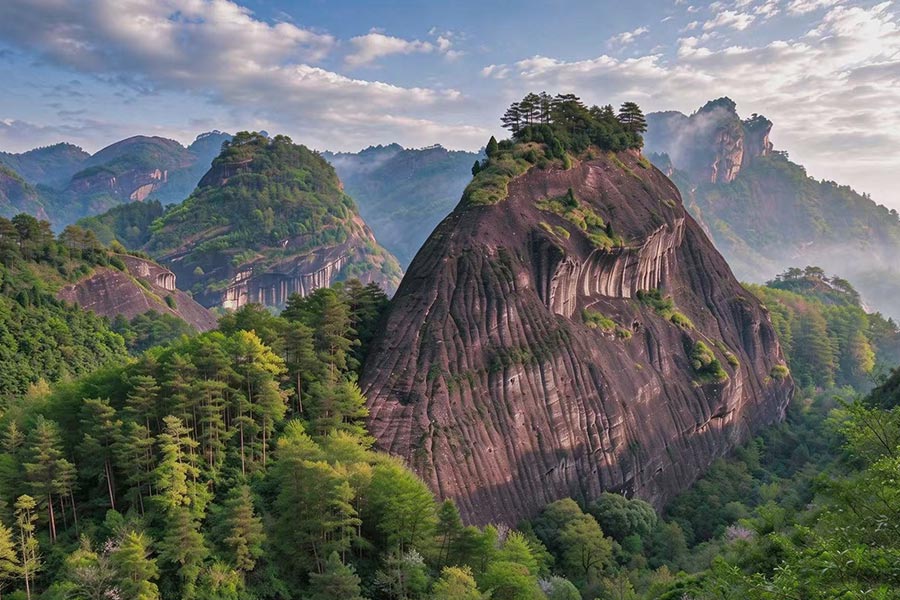
Chinese name: 虎啸岩 (Hu Xiao Yan)
Location: On the south bank of the Second Bend of Nine-Bend Stream, Wuyishan Scenic Area, between Jade Maiden Peak and One-Line-Sky.
Ticket: Included in the scenic area combo ticket; no separate admission.
Opening time: Summer 06:30–18:00; Winter 06:30–17:30.
Recommended time to visit: 1.5–2 hours.
How to get there: Take the scenic shuttle bus to the Tiger Roaring Rock stop. From the One-Line-Sky exit, it is a short walk. From the Nine-Bend Stream raft dock, walk south along the stream for about 5 minutes.
Introduction to Tiger Roaring Rock – Where the Wind Howls Like a Tiger
Tiger Roaring Rock gets its name from a natural acoustic phenomenon: when mountain wind rushes through a massive cave on the rock face, it produces a sound like a tiger’s roar echoing through the valley, shaking the surrounding peaks. The four characters “虎溪灵洞” (Tiger Stream Spirit Cave) are carved prominently on the cliff, a warning and an invitation in one.
The rock itself stands 510 meters above sea level, with cliffs rising sheer on all sides. Its shape resembles a crouching tiger, and the area is known for its “strange rocks and winding streams”— a blend of泉 (springs) and 石 (rocks) that creates a uniquely intimate landscape.
Haohan Slope (好汉坡, “Hero’s Slope”)
The steepest route to the summit. The zigzag path has sections inclined at 60–70 degrees, with narrow steps and a cliff edge beside you. It is not for the faint-hearted, but the climb is short and the reward is immediate.
Tiancheng Temple (天成禅院)
Built directly beneath an overhanging cliff, the temple’s massive rock ledge forms a natural roof—so the entire structure has no tiles and remains completely dry even in heavy rain. The temple preserves a Qing Dynasty relief carving of Guanyin. It is a remarkable example of architecture that simply fits into the mountain rather than imposing itself upon it.
Tiger Roaring Eight Scenes (虎啸八景)
The area encompasses eight named scenic spots, including Bailian Ferry (白莲渡), Jiyun Pass (集云关), and Yuer Spring (语儿泉). Some are harder to find than others, but the search is part of the experience.
The Summit and Dingming Bridge (定命桥)
At the end of the trail lies Dingming Bridge, perched over a narrow rock crevice. Just beyond it, an observation deck offers panoramic views of Wuyi’s 36 peaks. It is the payoff for the climb—and a quiet place to sit and let the wind do its tiger impression.
Practical Notes: The Haohan Slope is steep and narrow; not recommended for small children or those with a fear of heights. Descending via the Tiancheng Temple route is gentler than returning the same way.
Quick Questions
Our team is waiting for your questions. Please feel free to ask us any questions you might have about our China package tours, Chinese culture, or the sites available. We will gladly help you with any special needs you might have and all questions, like our trip designing is completely free of charge.

